
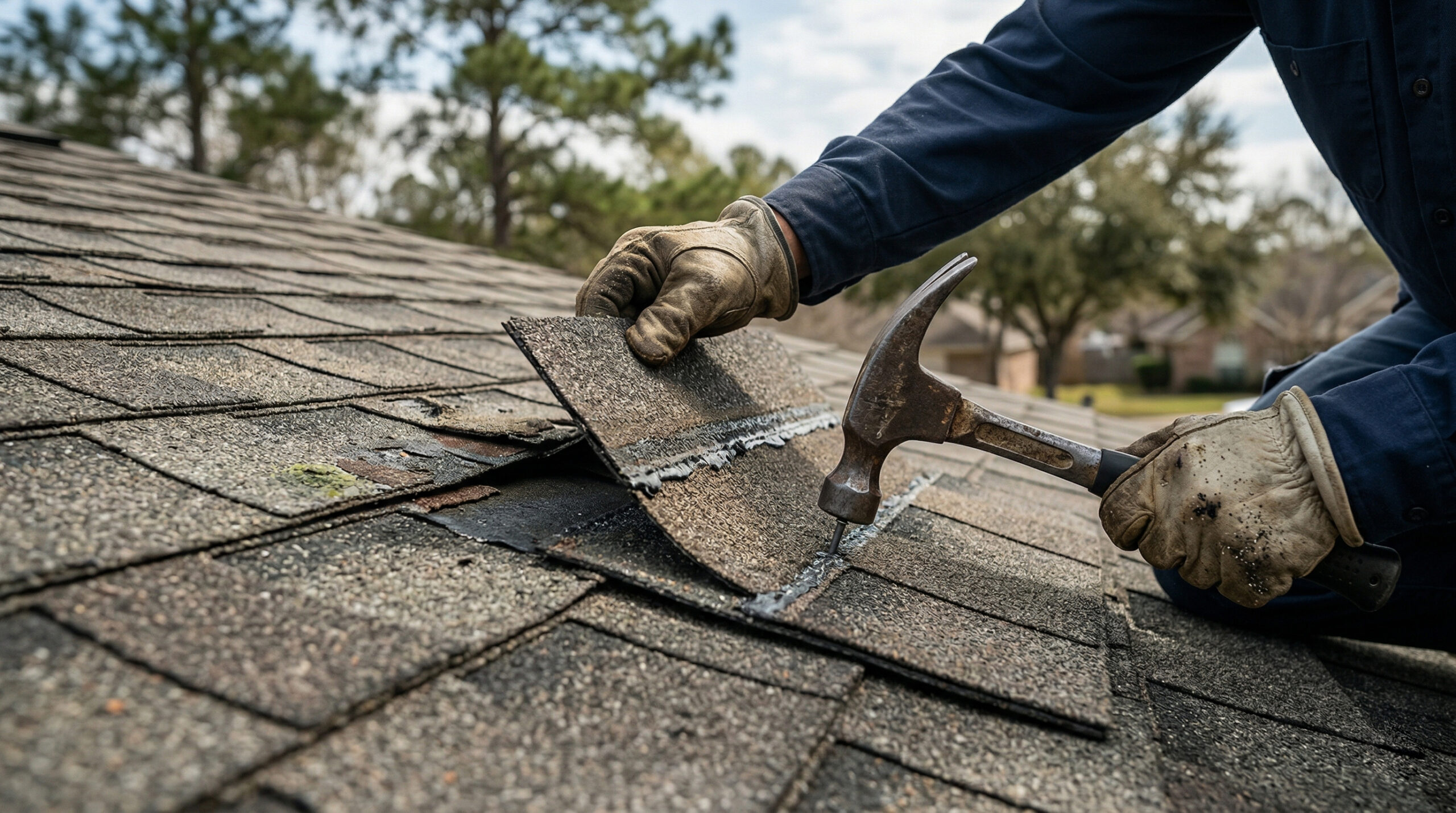
If something about your roof caught your attention after the last storm, you’re probably sitting with two questions. Is this actually serious? And what is fixing it going to cost me? Those are the right questions, and this article answers both of them directly — no filler, no pitch before you’ve gotten anything useful.
Nailed It Roofing Pros is a locally owned and operated roofing company serving Magnolia, TX and the surrounding areas — including The Woodlands, Tomball, and Conroe. Whether you’re looking for the right roofer in Magnolia for a minor repair or trying to figure out whether it’s time to get your roof replaced entirely, we work with homeowners across the Montgomery County TX area every day.
What follows is a practical account of what residential roof repair looks like in this market: the repair costs, the decisions, the insurance claim process, and what to watch out for when someone knocks on your door with a clipboard the day after a storm.
How to Tell If Your Roof Actually Needs Repair (And What Can Wait)
Not every roof problem is a crisis. Some damage needs to be addressed this week. Some can wait a month without making things worse. The problem is that most homeowners have no reliable way to tell the difference, and that uncertainty tends to push people in one of two wrong directions — they either panic over something minor, or they ignore something that’s quietly turning into costly repairs.
Here’s a practical way to sort it out.
Act immediately if you’re seeing any of these:
- Water actively dripping or staining your ceiling during or after rain
- A soft or spongy feel when walking on any section of the roof
- Visible sagging between rafters or at the ridge line
- Daylight coming through your attic boards during the day
- A musty smell in the attic that showed up recently
These are structural or active moisture-intrusion problems. They don’t stabilize on their own.
These can be monitored, but don’t require emergency calls:
- Missing shingles after mild wind, with no interior symptoms
- Granule buildup in gutters without visible cracking or bare spots on the shingles themselves
- Minor algae streaking on north-facing slopes
- Slightly lifted flashing with no active leak
The core distinction: one category means water is already inside your home’s structure. The other means your roof has become more vulnerable — damage that could lead to roof leaks eventually, but hasn’t yet. Both deserve attention. The timeline is just different.
What trips people up most is the geography of a leak. Where water enters your roof and where it shows up inside your house are almost never the same spot. It gets in through a failed flashing joint or a cracked shingle tab, then travels along the decking, down a rafter, across a joist, and drips onto your ceiling somewhere that looks completely unrelated to where the problem actually started. By the time you notice a stain above your living room, the water has been sitting somewhere it shouldn’t for longer than you’d want to know. That’s what makes “small leak” a dangerous label. The drip looks minor. What’s happening behind the drywall is a different conversation.
For Magnolia homeowners specifically, the tree canopy adds a variable most roofing articles don’t account for. The pines and oaks along FM 1488 and FM 1774 drop debris constantly, and a branch scrape or direct limb impact can leave damage that looks alarming from the ground but turns out to be isolated and straightforward to fix. That same tree cover holds moisture against your shingles longer than it would on an open lot, which speeds up granule loss and creates conditions for algae. Looks bad, usually isn’t structural — but it’s a hard call to make if you don’t know what you’re looking for.
The Gulf-fed systems that move through Montgomery County in spring and fall tend to linger, and that sustained exposure is often harder on older roofs than any one fast-moving storm. A single hard storm might not breach a roof that’s showing its age. Three days of rain will find every small gap, every slightly lifted tab, every flashing joint that’s overdue.
Not sure which category your situation falls into? Roof inspections from Nailed It Roofing Pros are free and can protect your home before a small problem turns into an expensive one — no pressure, no commitment, just a straight answer on what you’re actually dealing with.
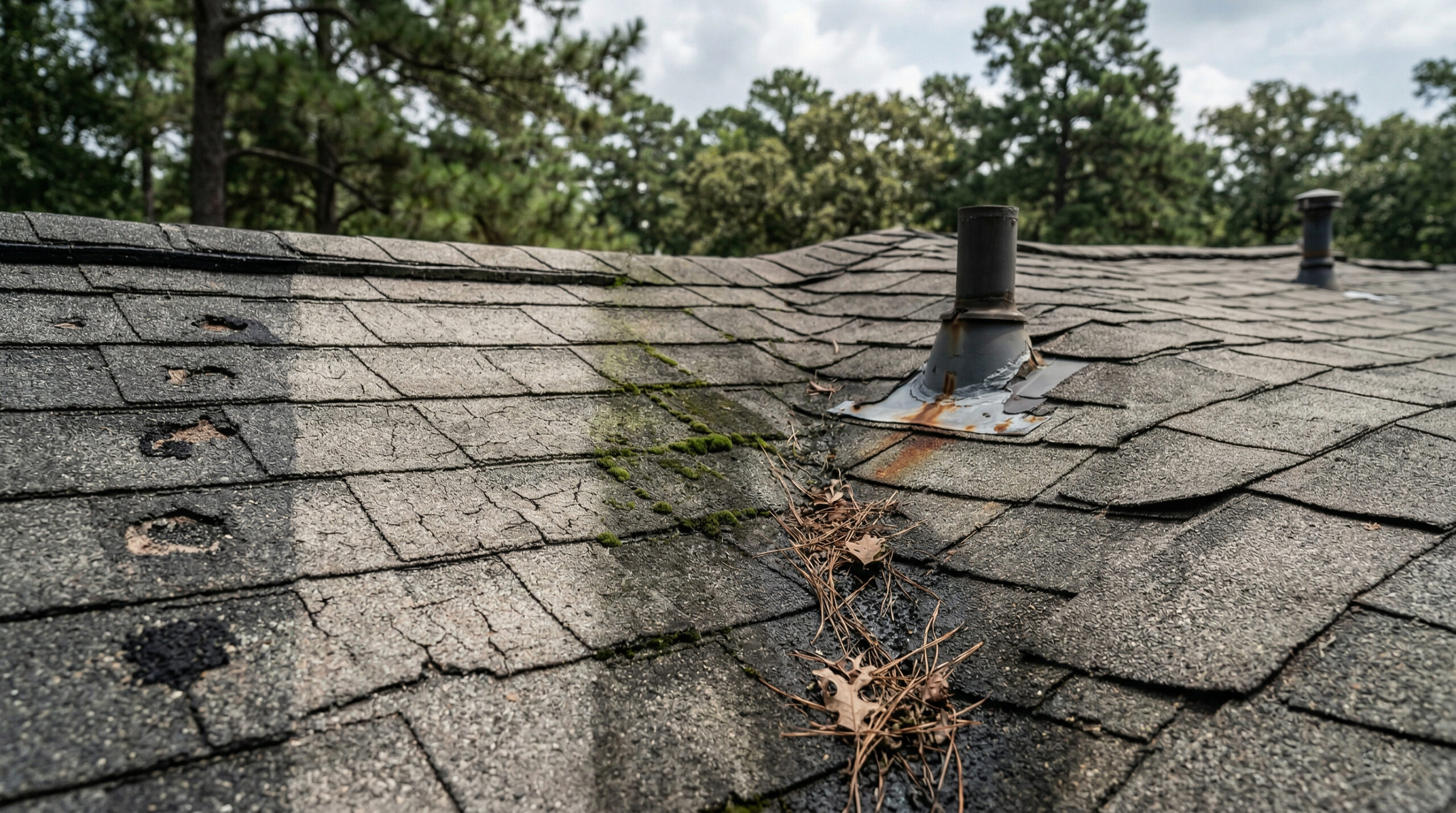
Common Causes of Roof Damage in Magnolia, Texas
Magnolia is a genuinely hard climate for roofing materials. Between the hail, the humidity, the heat, and the year-round tree debris, there are more ways for a roof to degrade here than in most parts of the country. Knowing what actually causes damage helps you catch problems earlier and have a more useful conversation with any roofer you bring out.
Hail Damage
Hail is the most common insurance claim trigger in Montgomery County, and the storms here are not minor events. Quarter-sized hail or larger is a realistic annual possibility, not a once-in-a-decade anomaly. The storm damage it causes isn’t always visible from the ground. What hail does is knock granules loose from your shingles, exposing the asphalt layer to UV. The shingle may look mostly intact — but it’s aging faster than it should, and that granule loss is exactly what insurers look for when assessing whether a roof qualifies for a claim.
Wind Damage
Wind damage is the other major culprit, particularly the sustained kind that comes with tropical remnants and fast-moving thunderstorm cells. Wind rarely tears shingles off cleanly. More often, it lifts tabs at the edges, breaks the sealant strip, and leaves shingles that look attached but are no longer doing their job. Water gets underneath them the next time it rains.
Flashing Failure
Flashing failure is behind more roof leaks than most homeowners realize. Flashing is the metal that seals roof transitions — around chimneys, along wall intersections, at dormers, around pipe boots and vents. It expands and contracts with temperature, and over time the sealant cracks, the metal pulls away, or the fasteners work loose. When a homeowner has a persistent leak they can’t explain, flashing is almost always where the inspection starts.
Algae and Moss
Algae and moss are more of a Magnolia-specific problem than they are in drier or more open parts of Texas. Heavy tree coverage means shaded roof sections stay damp longer after rain, which is exactly what algae needs to establish. The dark streaking it leaves is cosmetic in the early stages. Left alone for several years, moss root structure can lift shingles and accelerate granule loss beneath them.
UV Degradation
UV degradation is slower and more consistent than any storm, but it compounds. South- and west-facing exterior roof planes take a sustained beating over a Texas summer. Shingles dry out, lose flexibility, and become brittle — and a brittle shingle cracks under debris impact or hail that a newer shingle would have absorbed.
Tree Debris
Tree debris deserves its own mention because the mechanism is different from a direct strike. Pine needles collecting in roof valleys create a dam. That debris pile holds moisture, and the slow rot it produces in the valley flashing and underlying decking is often not discovered until a repair opens up the area. Homeowners on wooded lots along the older stretches of FM 1774 run into this more than most.
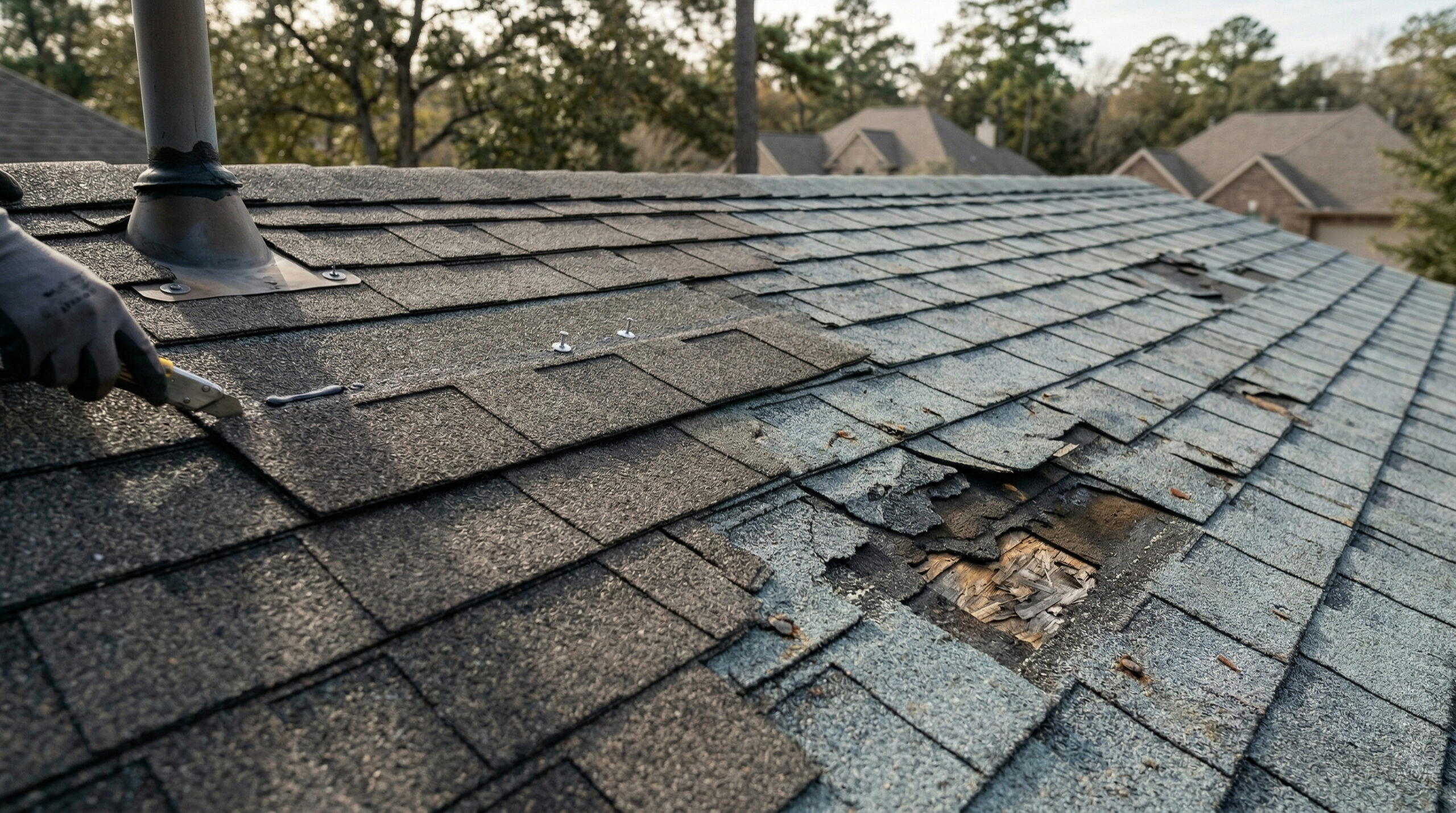
Repair or Replace? How to Make the Right Call
This is the question most homeowners are quietly dreading before the contractor even arrives. Nobody wants to hear they need a full roof replacement when they called about a leak. And nobody wants to spend $600 on a repair that buys them eight months before the next failure point shows up.
Here’s how to think about it honestly.
Repair makes sense when:
- The damage is isolated: one section of shingles, one failed flashing point, one cracked pipe boot
- The rest of the roof is in reasonably good condition with functional granule coverage
- The roof is under 15 years old, or under 20 years old with a quality architectural shingle that’s held up well
- The repair cost falls well below your deductible, making an insurance claim financially pointless
Replacement makes more sense when:
- The roof is 20 to 25 years old with widespread granule loss across multiple slopes
- Opening a repair area reveals decking rot that extends beyond what’s visible from the surface
- Hail or wind damage covers the full roof — in that situation, a partial repair typically won’t satisfy a legitimate insurance claim
- Active leaks are coming from multiple separate points, which suggests systemic failure rather than an isolated problem
A rough rule of thumb: if repair costs are approaching 30 to 40 percent of a total roof replacement, and the roof has significant age on it, replacing your roof usually wins on cost-per-year-of-useful-life. A new roof also delivers real improvements in energy efficiency and curb appeal that a patch simply can’t replicate. If you’re weighing a roof upgrade against extending the life of what you have, those longer-term gains are worth factoring in.
The type of roof on your home affects what your options look like, too. Most properties in Magnolia carry asphalt shingles — either 3-tab or dimensional architectural. Some have metal roofs, which follow different repair protocols, perform differently in this climate, and typically run higher in material cost on a roof replacement in Magnolia than asphalt alternatives. Whatever type you have, the repair vs. replace math works the same way.
One thing that comes up specifically in Magnolia: homes along the older FM corridors sometimes have original decking from the late 1980s or early 1990s. It’s not unusual to open up what looks like a straightforward shingle repair and find decking underneath that’s been quietly degrading. That discovery changes the scope of the job. Any honest roofer tells you that before proceeding, not after.
If you’re in a newer subdivision like Woodtrace or Audubon — or in areas near Magnolia like The Woodlands or Tomball — your roof is likely younger but may be approaching the age where minor issues start showing up with more frequency. HOA communities in Magnolia often require color-matched shingles for visible repair work, which affects material selection and can add a few days to scheduling if a specific line needs to be sourced.
If you’re on the fence between repair and replacement, that’s exactly what a free inspection is for. We’ll walk you through what we find and give you our honest read — not the recommendation that’s better for our invoice.
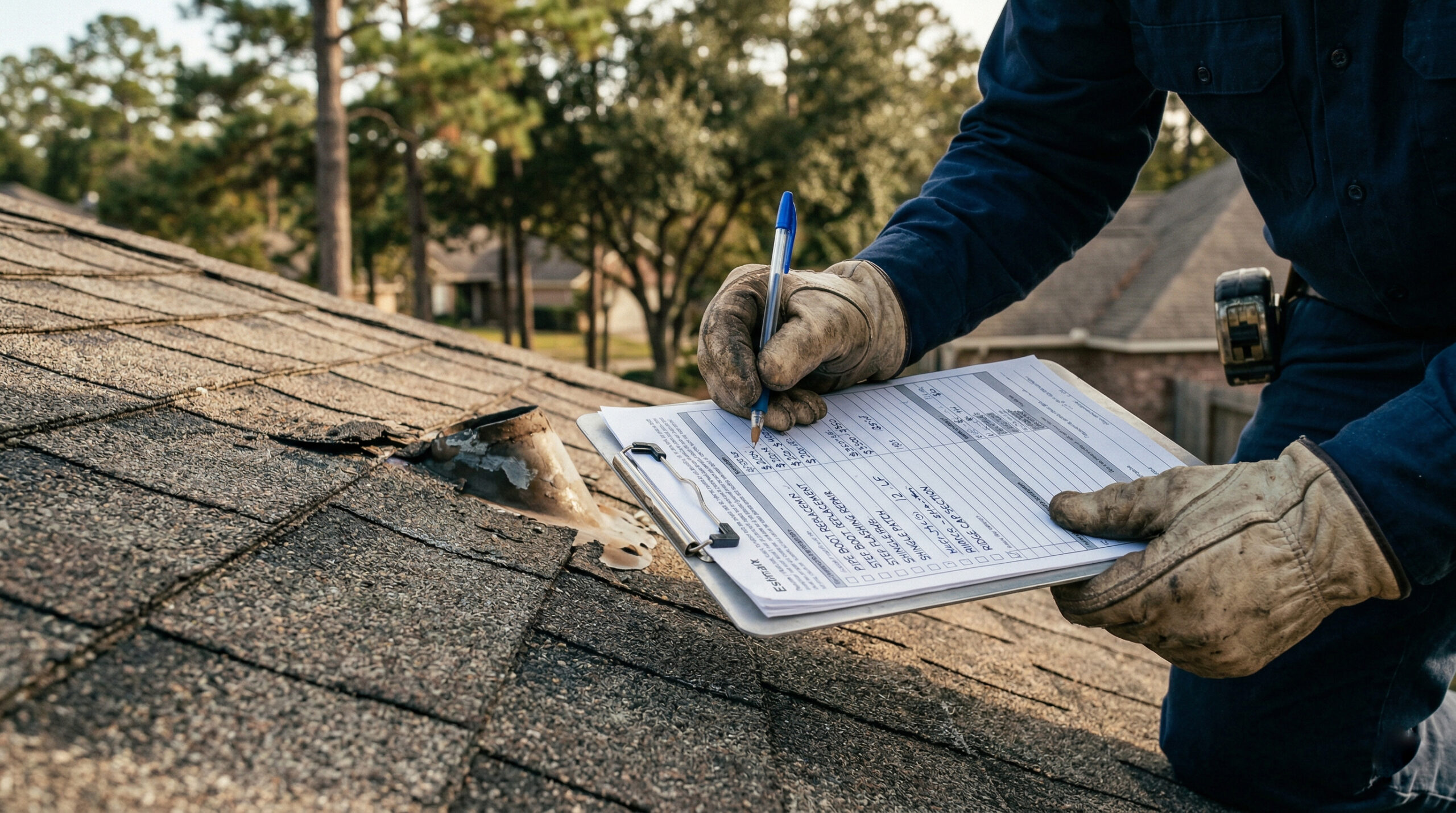
What Does Roof Repair Actually Cost in Magnolia, TX?
Most roofing websites won’t give you real numbers. They’ll tell you costs vary and suggest you call for a quote. Technically true, practically useless when you’re trying to figure out whether you’re looking at a few hundred dollars or a few thousand.
Here are realistic repair costs for common repair types in the Magnolia, TX market. These aren’t guarantees — pitch, access, material matching, and what’s underneath the visible damage all affect the final number. But these ranges reflect what homeowners in Montgomery County are actually paying for professional roof repair services.
Typical Roof Repair Costs by Type
| Repair Type | Estimated Cost Range |
|---|---|
| Pipe boot / collar replacement | $150 to $350 per penetration |
| Step flashing repair (chimney, dormer, wall) | $300 to $600 |
| Valley repair | $400 to $800 depending on length |
| Shingle patch (isolated section) | $250 to $600 |
| Ridge cap replacement (section) | $500 to $900 |
| Fascia or soffit repair | $400 to $1,200 |
| Emergency tarp after storm damage | $200 to $500 |
A few things push costs toward the higher end. Steep-pitch roofs require more safety equipment and take longer to work safely. Two-story homes with limited access cost more in labor. If decking damage is discovered once a repair area is opened, that adds materials and time — decking replacement runs roughly $70 to $100 per sheet installed, and a moderate repair area can require several sheets if moisture has been sitting for a while.
What keeps costs lower is equally straightforward: isolated damage on an accessible section of a single-story home, using a standard architectural shingle that’s easy to source locally. Most common repairs — a boot replacement, a section of step flashing, a shingle patch — come in well under $1,000 when the scope stays contained.
One market-specific note: after a significant hail event in Montgomery County, roofing labor demand spikes fast. Contractors book out, material suppliers move inventory quickly, and labor rates can climb for several weeks. If your damage isn’t in the emergency category, getting on a schedule before the storm-season rush is usually the smarter financial move.
Want a number specific to your roof? We provide free written estimates with a full scope of work and no obligation to move forward. Call Nailed It Roofing Pros or use the contact form to get scheduled.
Learn More: How Much Does A New Roof Cost in Houston?
Does Homeowner’s Insurance Cover Roof Repairs in Texas?
Sometimes — and the answer depends on two things that often don’t match: what caused the damage, and what your policy actually says.
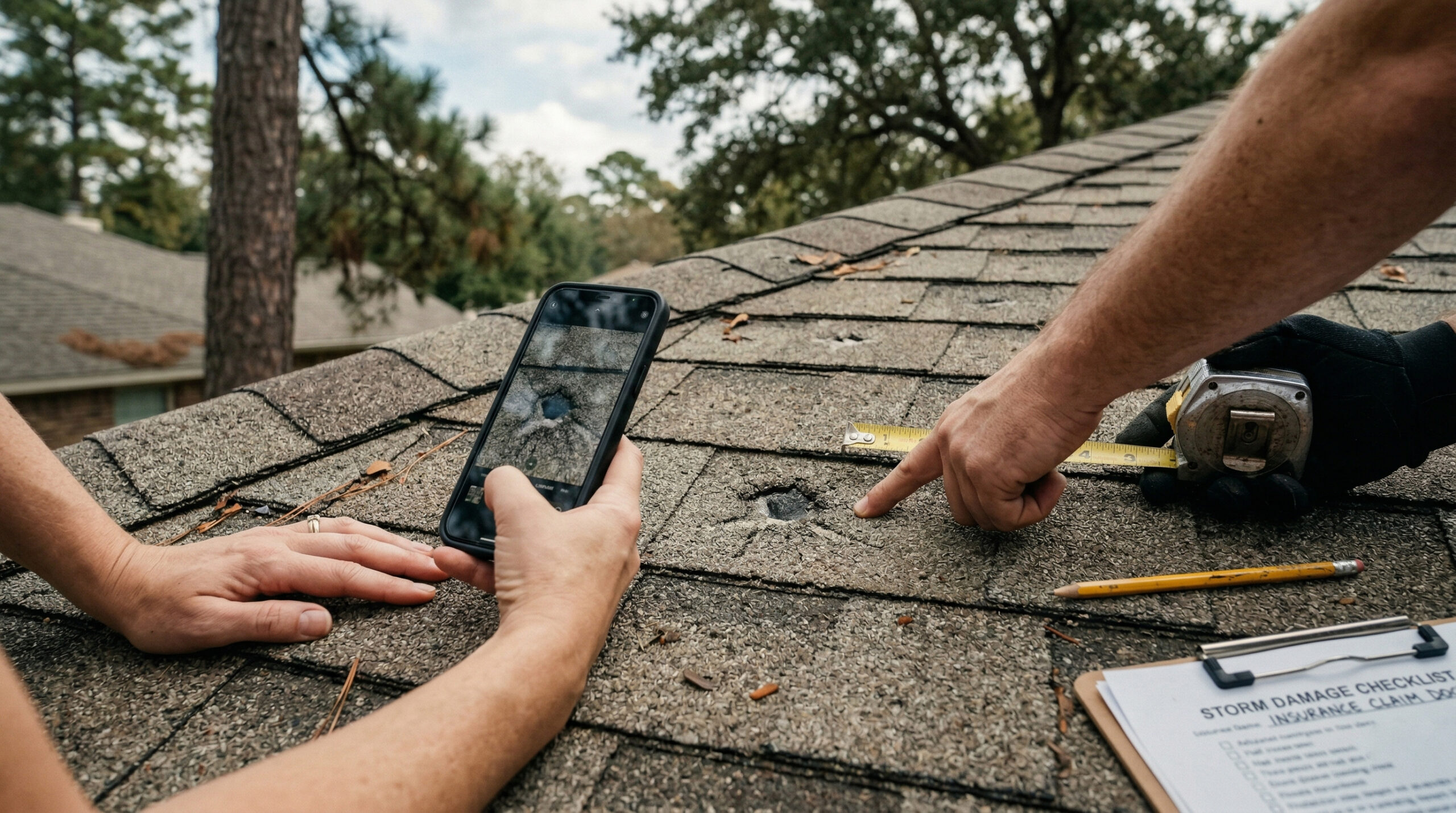
Texas homeowner’s insurance typically covers sudden, storm-caused damage: hail, wind, a tree coming down on your roof. It doesn’t cover gradual wear, maintenance neglect, or damage that developed over time without a triggering weather event. If your roof is 22 years old and the shingles are failing from age, that’s not a covered loss. If a hail storm knocked the granules off a 22-year-old roof and the adjuster can document it, it may well be.
Before you file anything, there’s one policy detail worth understanding.
ACV vs. RCV: Know Which One You Have
Homeowner’s policies pay out roof claims in one of two ways, and most people don’t find out which they have until they’re already mid-claim.
Actual Cash Value (ACV) pays out the depreciated value of your roof. A 15-year-old roof on a 20-year shingle has depreciated significantly, and your check reflects that. It may not come close to covering the actual cost of repair or replacement.
Replacement Cost Value (RCV) pays what it actually costs to repair or replace the roof at today’s prices, minus your deductible. Check your declarations page now, before you need it, to confirm which one applies to you.
How the Claim Process Works
- Document the damage as soon as it’s safe. Photos, dates, and any weather records — local news coverage, National Weather Service data — help establish the timeline with your insurer.
- Open the claim with your insurance company. Most Texas carriers have a filing window, often one year from the storm date, but filing sooner protects your options.
- Get an independent contractor estimate before the adjuster visits if possible. The adjuster’s scope of loss shouldn’t be the only number on the table.
- Review the adjuster’s scope against your contractor’s estimate. Discrepancies are negotiable. A contractor with insurance claim experience can identify items that were missed or undervalued in the adjuster’s scope.
- Once the claim is approved, work is scheduled. Your deductible is your out-of-pocket cost.
One Texas-specific detail that catches people off guard: wind and hail deductibles are often calculated separately from your standard deductible, as a percentage of your home’s insured value. A 2% wind/hail deductible on a home insured at $350,000 means $7,000 out of pocket before insurance pays anything. If your repair estimate comes in below that threshold, filing an insurance claim may not make financial sense. That’s not a reason to skip the inspection — it’s a reason to have an accurate estimate before you decide whether to file.
Montgomery County sees high claim volume after major weather events, and adjusters get backed up. Documenting thoroughly and filing promptly both help move your claim forward.
We’ve helped Magnolia homeowners navigate this process from first inspection to final approval. If you think a recent storm caused roof damage, it’s worth getting a professional assessment before your filing window closes. Call us and we’ll get eyes on it.
The Storm Chaser Problem in Magnolia (And How to Spot One)
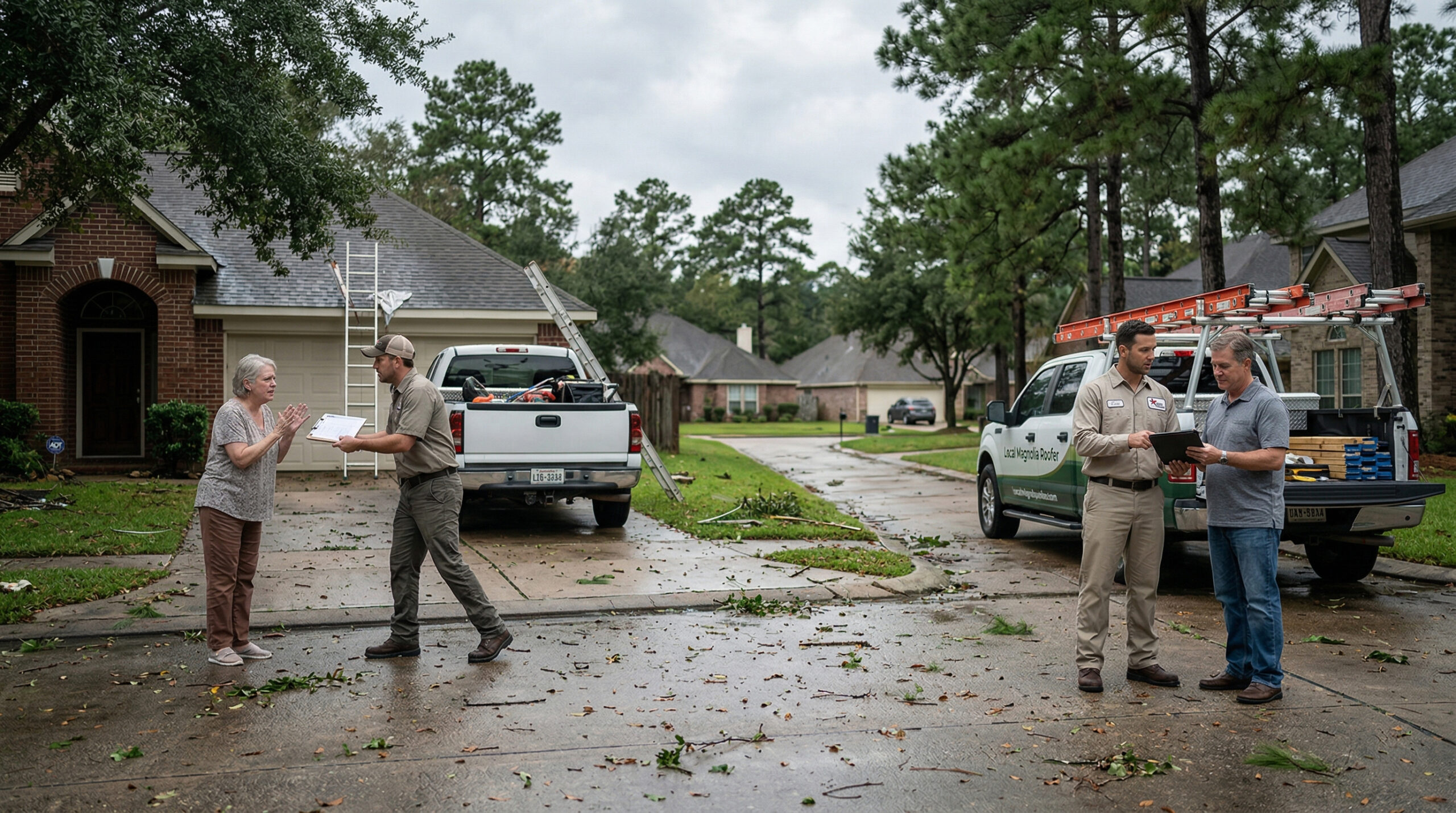
After any significant hail or wind event in Montgomery County, the pattern is predictable. Within days, out-of-area roofing crews start appearing. Trucks with out-of-state plates, door-to-door canvassing in the neighborhoods that took the hardest hits, offers for a “free inspection” that somehow ends with a signed contract before you’ve had time to read what’s in front of you.
Storm chasers are a documented problem in this market. Not all of them are fraudulent, but the business model most operate on isn’t built around your long-term interests. They move in volume, work fast, and are on to the next market before anyone has a reason to call back with a warranty question.
Red flags worth taking seriously:
- No verifiable Texas business address. A P.O. box or a number that routes to a call center isn’t the same thing.
- Out-of-state license plates on work trucks.
- Pressure to sign anything before you’ve had time to review it or get a second opinion.
- A request for full payment or a large deposit before work starts.
- Estimates given verbally with no written scope of work to follow.
- Any mention of an Assignment of Benefits agreement, which transfers your insurance rights to the contractor. This arrangement has a troubled history in Texas and deserves careful scrutiny before you sign one.
Before hiring any roofing contractor in Magnolia, TX, ask:
- Do you carry general liability insurance and workers’ compensation? Can you provide certificates before the job starts?
- How long have you been operating specifically in Montgomery County?
- Will you provide a written, itemized estimate before I sign anything?
- What is your physical business address?
Texas has no statewide roofing license requirement, which makes vetting more important here than in states with stricter entry standards. Licensed roofers who carry proper insurance, maintain a physical address, and back their work with a written warranty are the baseline you should hold any trusted roofing company to. The barrier to calling yourself a roofer in Texas is low. The barrier to doing it well and being reachable a year later is considerably higher.
Nailed It Roofing Pros is locally based — not a traveling crew, not a franchise with rotating field teams. We work in this area, our reputation is built here, and we’re not going anywhere after your job is done. If you’ve already received an estimate and want a second opinion before committing to anything, we’re glad to take a look with no strings attached.
What the Roof Repair Process Looks Like (Start to Finish)
A lot of homeowners hesitate to make the first call because they’re not sure what they’re agreeing to. Knowing what the process actually looks like — start to finish — tends to make that call feel a lot less uncertain.
Here’s how a standard residential roofing project goes with Nailed It Roofing Pros.
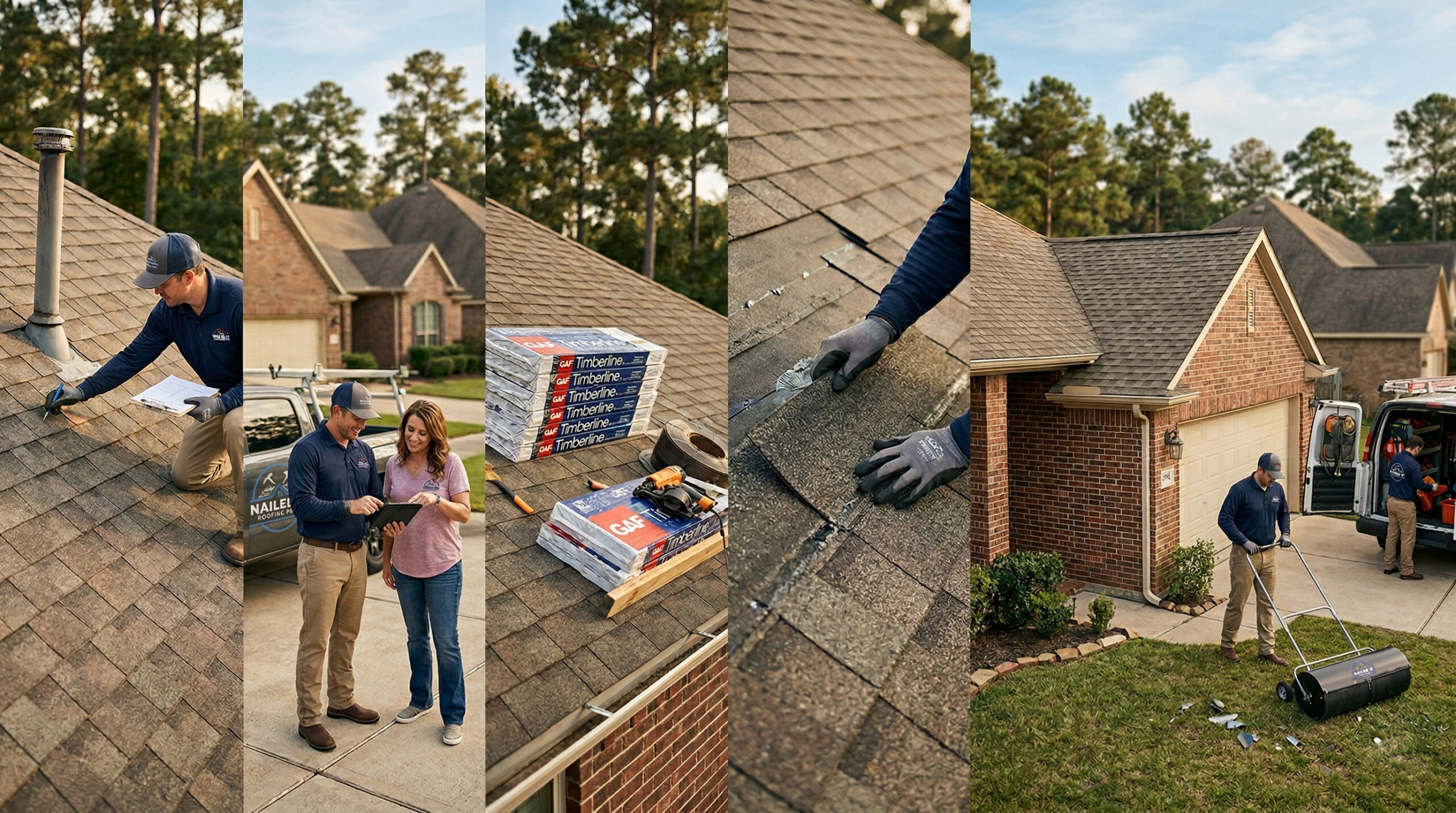
Step 1: Free roof inspection.
We look at the roof surface, the attic if access is available, the flashing points, the gutters, and any exterior areas where water might be finding its way in. We also check attic ventilation while we’re up there — it affects shingle lifespan and is easy to overlook on a standard walkthrough. We’re looking for the source of the problem, not just the visible symptom. Depending on roof size and complexity, this typically takes 30 minutes to an hour. You’ll know what we found before we leave.
Step 2: Written estimate.
Before anything is signed, you receive a written scope of work with line items — what’s being repaired, what materials are being used, and what it costs. No vague totals, no verbal agreements you’re expected to rely on later.
Step 3: Material sourcing and scheduling.
Most standard repairs use architectural shingles that are readily available locally. We work with quality products from GAF-certified lines and CertainTeed’s residential shingle systems, which include proper underlayment built for the Texas climate. Whether it’s a targeted repair or a larger installation project, materials are matched to your roof and sourced to manufacturer standards for professional installation. For older homes with discontinued lines or HOA color-match requirements, there may be a short lead time. We’ll flag that upfront if it applies.
Step 4: The repair.
Most residential roof repair work in Magnolia is finished in a single day. A boot replacement or shingle patch might take two to three hours. A valley repair or more involved flashing job might run most of a day. You don’t need to be home for the work, but we’ll walk you through what was done when we finish.
Step 5: Cleanup and walkthrough.
We clear the work area, run a magnet for fasteners in the yard where applicable, and walk you through what was repaired and what to watch going forward. Every repair and roof installation we complete comes with a written warranty covering our workmanship. If we found something during the repair that warrants a follow-up conversation, we have it before you sign off — not after.
On permits: most isolated residential roof repairs in Texas don’t require one. Work involving significant structural or decking replacement may. We handle that determination during job scoping.
If you’d like to get scheduled, the fastest way is to call us directly or fill out the contact form. We’ll confirm a time and give you a specific timeline for your roof before any work begins.
Why Magnolia Homeowners Work With Us
There’s no shortage of roofing companies willing to take a job in Montgomery County, especially in the weeks after a storm. What’s harder to find is a residential roofing contractor who’s been here long enough to know this housing stock, has worked through enough local insurance claims to actually be useful during one, and will tell you a repair is all you need when that’s genuinely true.
Nailed It Roofing Pros is a locally owned and operated roofing company in Magnolia, TX — not a franchise, not a regional brand with a call center and rotating field crews. We’re BBB – accredited and GAF certified, which means we meet manufacturer standards for quality workmanship and professional installation on every job. We also work with CertainTeed’s certified roofing product lines, which carry extended material warranties that protect your investment long after the job is done.
Our experience in roofing across Montgomery County means we understand how the local climate, housing stock, and soil conditions affect every type of roof differently. Whether the work is a minor repair, a full replacement, or roofing and construction services for a renovation or new construction project, we approach every roofing project the same way: straight assessment, quality work, and a written scope before anything starts.
Some homeowners ask whether we’re the best roofing company in Magnolia. We’ll let the work answer that. What we can tell you is that the best roofers in Magnolia are the ones who show up, give you a fair assessment, do the job right, and are still reachable when you call a year later. That’s the standard we hold ourselves to on every roof we touch.
Our estimates are written and itemized before anything is signed. General liability insurance and workers’ comp certificates are available before any job starts. And if your roofing needs are straightforward — a leak, some wind damage, a few problem areas — our repair services are designed to solve the actual problem, not upsell you past it. Customer satisfaction built on honest recommendations is what keeps this business running.
Call Nailed It Roofing Pros for a free roof inspection. No commitment, no pressure — just a clear picture of what you’re dealing with and what it will take to fix it.
We also handle commercial roofing for smaller properties and mixed-use buildings in the area. If your roofing needs go beyond standard residential work, ask us what roofing solutions we can offer.
Wrapping Up
Most roof damage in Magnolia is repairable when it’s caught early. A timely repair is almost always less expensive than what you’re facing after a minor problem has had one or two storm seasons to compound. That’s not a scare tactic — it’s just how water and wood behave over time.
If something has been on your radar, an inspection is the fastest way to find out whether you’re dealing with something urgent, something manageable, or something you can monitor for now. There’s no cost to knowing where you stand. Protect your investment before a repairable problem turns into a full replacement conversation.
We’re based in Montgomery County, serving Magnolia TX, The Woodlands, Tomball, and surrounding communities throughout the TX area. If you’re near Magnolia and need a roofer who’s going to give you a straight answer, we’re one call away. Call Nailed It Roofing Pros and let’s take a look.
Frequently Asked Questions
How long does a roof repair take in Magnolia, TX?
Most isolated repairs — shingle patches, boot replacements, flashing work — are finished in a single day. If decking damage is discovered once a repair area is opened, that may extend the job into a second day. We give you a realistic timeline in the written estimate before work begins.
Will filing an insurance claim affect my premiums?
It can, depending on your carrier and your claim history. A paid repair that doesn’t involve an insurance claim has no effect on your premium. Whether it makes sense to file depends on your deductible, the repair estimate, and how recently you last filed. We can help you think through the numbers, but the final decision is between you and your insurer.
How soon after a storm should I have my roof inspected?
Within 30 days is a sound guideline. Most Texas policies have a claim filing window, and damage that’s clearly attributable to a specific storm becomes harder to document as time passes. Waiting also gives water more chances to turn a small problem into a larger one. Getting an inspection done early costs nothing and keeps your options open.
Can I repair my own roof?
Emergency tarping to stop active water intrusion is reasonable. Permanent repairs are a different situation. Working on a pitched roof carries real fall risk, improper repairs can void manufacturer warranties, and work that isn’t done correctly often creates new leak points in the process of addressing old ones. The savings rarely hold up against those tradeoffs.
How long do asphalt shingle roofs last in the Magnolia climate?
Standard 3-tab shingles typically run 15 to 20 years. Dimensional architectural shingles are rated for 25 to 30 years, though Magnolia’s UV exposure, humidity, and heat tend to push real-world performance toward the lower end of that range. Roofs on heavily shaded lots may see faster algae-related degradation even when the underlying shingles are in decent shape.
What happens if I ignore a roof leak?
Water enters through a small gap, saturates insulation, compromises drywall, and eventually creates conditions for mold. A $400 repair at the start can reasonably become a $4,000 to $6,000 problem once drywall, insulation, and decking replacement are factored in. The leak looks the same size the whole time. The damage behind it doesn’t stay that way.
Do roofing contractors in Texas need to be licensed?
Texas has no statewide roofing license requirement. That makes vetting roofing services more important here than in states with stricter entry standards. Before hiring anyone, ask for proof of general liability insurance, workers’ compensation coverage, and a verifiable local business address. Licensed roofers who maintain proper certification and insurance are the standard you should hold any contractor to — residential roofing contractor or otherwise.
How do I know if my roof damage is covered by insurance?
Sudden storm-caused damage — hail, wind, a falling tree — is typically covered. Damage from gradual wear or aging materials generally isn’t. Whether your specific situation qualifies depends on your policy language and what the adjuster documents. We can help you photograph and record damage in a way that supports a legitimate insurance claim from the start. If you want to get that right before you file, give us a call before you contact your insurer.